


The Free-Rider Problem
👇 Get new sketches each week
Sharing the reward without the effort
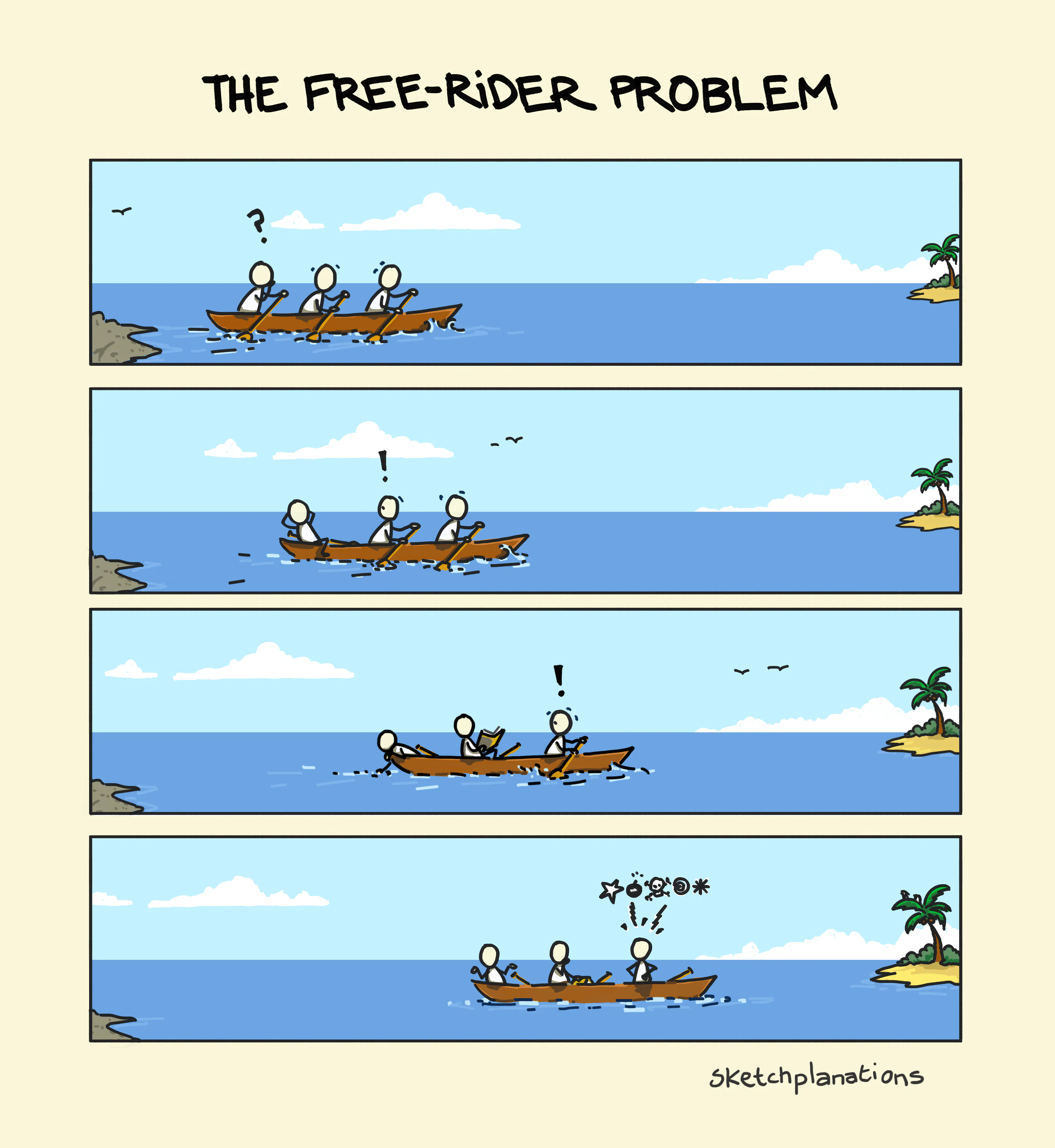
Ever been on the back of a tandem bike and been tempted not to pedal? Or at the back of a canoe or kayak and thought about easing off on the paddling? This is the free-rider problem.
More generally, when a person can enjoy the benefits of a group’s efforts whether they contribute or not, there’s an incentive to let others do the work.
Assuming somebody keeps paddling, then the craft will get to its destination, and as long as you’re sat in it, you’ll get there too, whether you paddle or not.
What is the free-rider problem?
Here’s Elinor Ostrom in her book Governing the Commons :
“Whenever one person cannot be excluded from the benefits that others provide, each person is motivated not to contribute to the joint effort, but to free-ride on the efforts of others. If all participants choose to free-ride, the collective benefit will not be produced.
The temptation to free-ride, however, may dominate the decision process, and thus all will end up where no one wanted to be.”
Examples of the free-rider problem
Unless you are rather lucky, the free-rider problem is a common experience in group projects at school or at work. It’s easy to resent the team member who contributes half as much and gets the same grade.
I’ve also experienced the free-rider problem in:
- group litter picks
- living in a shared student kitchen—everyone benefits when somebody cleans
- Wikipedia—so many people benefit from the voluntary work and contributions of a small number of people
- organising activities or trips (sometimes it might have been me doing the free-riding 😬)
- team sports—“as long as someone’s back defending, we’ll be fine.”
- arriving “fashionably” late at parties—which only works if other people arrive on time
- and the joy of free-riding much of my childhood, with dinner cooked, clothes washed, and the house cleaned whether I helped or not (Thanks, mum and dad!)
Free-riding can scale from the shared kitchen all the way up to countries.
As a classic example, if everyone else is sticking to fishing quotas to maintain fish stocks, an individual fisher might feel they don’t have to stick to it. The free-rider gets the benefit of everyone’s conservation efforts without making the same sacrifice. This overlaps with another collective-action problem, the tragedy of the commons.
Other larger-scale cases include:
- clean air and climate action—our atmosphere and oceans are perhaps the ultimate common resource. Every country benefits from others' efforts to reduce carbon emissions, and vice versa.
- vaccination—when enough people are immune, the reduced spread of disease can also help protect people who aren't immune. This herd immunity can create an incentive to free ride on others getting vaccinated.
- paying taxes—public services continue to function for someone who avoids paying their fair share, provided enough people are paying theirs.
In each case, the temptation is the same: if I still get the benefit, why should I contribute?
Most of us, however, continue to paddle. Let’s not be that person at the back.
Related Ideas to the Free-Rider Problem
Also see:
- The Responsibility Poem, or Whose job is it?
- The accountability ladder
- The Tragedy of the Commons
- The Abilene Paradox—another case of all ending up where no one wanted to be.
- Groupthink
- Herd immunity
- Canoe or Kayak?